MediSave for Maternity and Your Newborn
MediSave can pay much of the cost of having a baby in Singapore — pre-delivery care, the delivery and the ward stay, from both parents' accounts — and every Singapore Citizen newborn gets a MediSave Grant that funds their vaccinations, hospital bills and MediShield Life.
On this page10 sections · tap to jump
- 01What the MediSave Maternity Package covers
- 02Whose MediSave can you use
- 03The withdrawal limits, category by category
- 04How the claim is made
- 05The MediSave Grant for Newborns
- 06What a child’s MediSave pays for
- 07MediShield Life from day one
- 08Extra help for a third child: the LFMG
- 09FAQ
- 10How it all fits together
MediSave is the health-savings part of CPF, and it does a lot of quiet work around a new baby. It can pay for pregnancy check-ups, the delivery and the hospital stay, and then it follows the child — a brand-new MediSave account is opened for every Singapore Citizen newborn to help with vaccinations, hospital bills and insurance premiums. This page explains how those pieces fit together, with the current limits from the CPF Board, MOH and Made For Families (as of October 2026). For the total price of giving birth by ward type, see our pregnancy and delivery costs guide; here the focus is the MediSave mechanics.
What the MediSave Maternity Package covers
The MediSave Maternity Package (MMP) lets you tap MediSave for three categories of maternity spending:
- Pre-delivery medical care — consultations, ultrasound scans, tests and medications.
- The delivery procedure itself.
- Daily hospital charges for the stay — ward fees, treatment, investigations and medicines.
You do not have to use MediSave for every category. If you would rather keep cash flowing from MediSave only for the big-ticket delivery, you can skip the pre-delivery claims and still use it for the procedure and ward charges.
Whose MediSave can you use
This is the part many parents miss: the package applies to Singapore Citizens and Permanent Residents, and you may draw on your own or your spouse’s MediSave Account. Pooling two accounts roughly doubles the usable balance, which matters if one parent’s MediSave is thin. The hospital must be MediSave-accredited — all public hospitals and the main private maternity hospitals are.
The withdrawal limits, category by category
Pre-delivery care is capped at up to S$900, payable from either parent’s MediSave. The delivery procedure has its own limit depending on complexity. The table below shows the limit for the delivery alone, and the combined MediSave Maternity Package limit, which bundles in that S$900 pre-delivery allowance.
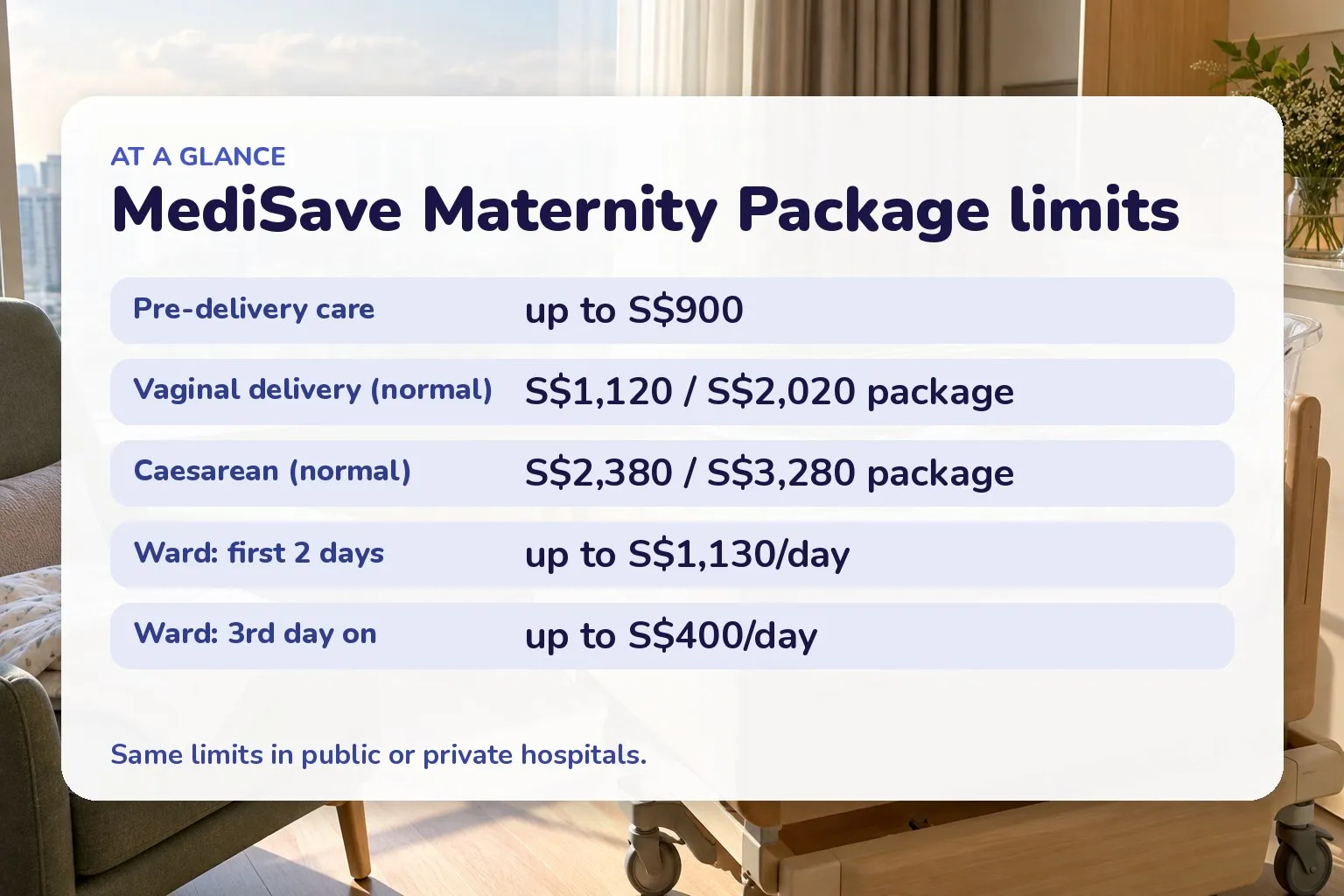
MediSave Maternity Package withdrawal limits. Source: CPF Board, October 2026.
| Type of delivery | Delivery procedure limit | Combined package limit* |
|---|---|---|
| Vaginal delivery (normal) | S$1,120 | S$2,020 |
| Vaginal delivery (assisted) | S$1,390 | S$2,290 |
| Caesarean section (normal) | S$2,380 | S$3,280 |
| Caesarean with tubal ligation | S$2,440 | S$3,340 |
| Caesarean with hysterectomy | S$2,770 | S$3,670 |
*The combined limit includes up to S$900 of pre-delivery expenses. Source: CPF Board.
On top of those, daily hospital charges are claimable at up to S$1,130 per day for the first two days of admission and up to S$400 per day from the third day onwards. A key point for budgeting: these withdrawal limits are the same whether you deliver in a public or a private hospital, so choosing a private hospital does not shrink what MediSave will pay — it only raises the cash portion of a bigger bill. You can always claim the actual bill or the limit, whichever is lower.
How the claim is made
For the delivery and daily hospital charges, the hospital submits the MediSave claim for you — there is no separate form. Pre-delivery care works a little differently when your check-up clinic is not the hospital where you deliver: keep those bills and present them to the delivering hospital afterwards, and it will submit them together with the delivery claim under the package.
The MediSave Grant for Newborns
Once the birth is registered, CPF opens a MediSave account for the child and credits the MediSave Grant for Newborns (MGN) automatically — no application. The amount depends on the date of birth:
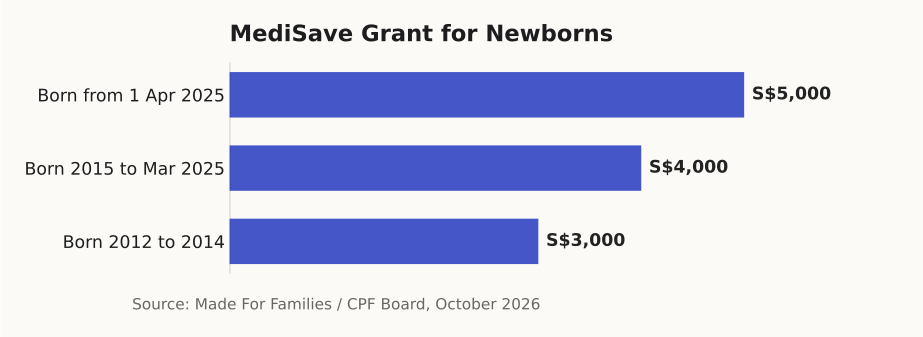
MediSave Grant for Newborns by the child’s date of birth. Source: CPF Board / Made For Families.
| Child born | MediSave Grant for Newborns |
|---|---|
| On or after 1 April 2025 | S$5,000 |
| 1 January 2015 – 31 March 2025 | S$4,000 |
| 26 August 2012 – 31 December 2014 | S$3,000 |
The grant lands in the child’s own MediSave account, usually within a week of birth registration, and the account earns 4% interest a year. You will get a notification once it is in, and can check the balance at the CPF child dashboard with your Singpass.
What a child’s MediSave pays for
The newborn grant — and any later MediSave in the child’s account — is designed to cover a child’s real early-years health costs:
- MediShield Life premiums for the child.
- Recommended childhood vaccinations under the National Childhood Immunisation Schedule (NCIS): Hepatitis B, the 5-in-1 and 6-in-1 combinations, MMR, pneumococcal, varicella, influenza and more.
- Newborn health screening — hearing, G6PD deficiency, metabolic and thyroid-function tests.
- Hospitalisation and approved outpatient treatments.
You can pay a child’s screening and NCIS vaccinations from your own or an immediate family member’s MediSave, not only the child’s. Routine outpatient uses such as vaccinations and health screenings fall under the MediSave500/700 limits — up to S$500 per patient per year (S$700 for those with complex chronic conditions).
MediShield Life from day one
Every Singapore Citizen newborn is covered from birth under MediShield Life once the birth is registered — including congenital and neonatal conditions, with no assessment for pre-existing conditions. That is a meaningful protection: a baby who needs treatment for a condition present at birth is already insured. MediShield Life and MediSave also help with serious pregnancy complications. Over 2018–2020, Singaporean parents paid under S$200 in cash on average for a subsidised newborn’s hospitalisation or day-surgery bills beyond the delivery.
Extra help for a third child: the LFMG
If your third or subsequent Singapore Citizen child is born on or after 18 February 2025, the family also receives a S$5,000 Large Family MediSave Grant (LFMG) — on top of the newborn’s own MGN. Unlike the MGN, the LFMG is credited to the mother’s MediSave account (about two weeks after the child’s Baby Bonus enrolment) and can pay medical expenses for her and her family.
FAQ
Can I use the grant for a baby born overseas? Yes. A child born overseas qualifies for the MediSave Grant for Newborns once the birth is registered with ICA directly or through a Singapore Overseas Mission, as long as the child is a Singapore Citizen. If citizenship is only obtained later, the grant amount follows the date citizenship is granted — and a child who becomes a citizen after turning 2 is not eligible.
Whose MediSave can pay for my child’s jabs and screening? Your own or an immediate family member’s MediSave can cover a child’s newborn health screening and NCIS vaccinations — you are not limited to the child’s own account, which is useful while the child’s balance is still small.
What if our combined MediSave can’t cover the delivery? MediSave pays up to the withdrawal limit or the actual bill, whichever is lower; anything beyond that is settled in cash or through an Integrated Shield Plan. Because both parents’ accounts can be tapped, a shortfall in one account can often be covered by the other.
How it all fits together
Around a birth, the money works in layers: the Maternity Package draws down your and your spouse’s MediSave for the pregnancy and delivery; the MediSave Grant for Newborns opens the child’s own health fund; and MediShield Life insures the child from day one. Alongside these sit the cash-and-savings help of the Baby Bonus and CDA, paid maternity and paternity leave, and tax relief such as the Working Mother’s Child Relief. None of these needs the others — but together they cover most of a Singaporean family’s early costs.
Related
- Pregnancy and delivery costs in Singapore
- Baby Bonus scheme explained
- Maternity and paternity leave
- Working Mother’s Child Relief explained
General information, not medical or financial advice. MediSave limits and grant amounts change — check the official CPF, MOH and Made For Families pages before you budget.
Sources
- What you need to know about the MediSave Maternity Package — Central Provident Fund Board (as of October 2026)
- MediSave Grant for Newborns — Made For Families (Government of Singapore) (as of October 2026)
- What is the MediSave Grant for Newborns? — Central Provident Fund Board (as of October 2026)
- Using MediSave for outpatient treatments — Central Provident Fund Board (as of October 2026)
- Large Families Scheme — Made For Families (Government of Singapore) (as of October 2026)
- Congenital birth issues and maternity insurance (newborn MediShield Life cover) — Ministry of Health (as of October 2026)