Working Mother's Child Relief (WMCR) Explained

Working Mother's Child Relief lets an eligible working mother cut her taxable income for each Singapore Citizen child. For a child born or adopted from 1 January 2024 it is a fixed S$8,000, S$10,000 or S$12,000 by birth order, not a percentage of her pay.
The Working Mother’s Child Relief (WMCR) is a tax relief that rewards mothers who keep working after having children. It reduces the income you are taxed on, once for each Singapore Citizen child. The scheme was reshaped from the Year of Assessment (YA) 2025: for children born or adopted on or after 1 January 2024, WMCR is now a fixed dollar amount instead of a percentage of your pay. This guide sets out both sets of rules, the caps that limit your claim, and a worked example — all from IRAS, current as of October 2026.
What WMCR is and who can claim
WMCR exists to encourage married women to stay in the workforce after having children, to encourage parents to take up Singapore Citizenship for their children, and to reward families with citizen children. You can claim it if, in the year before the YA, you were a working mother — married, divorced or widowed — with earned income, and your child is a Singapore Citizen who meets the child conditions below.
The big change: fixed dollars from 1 Jan 2024
As part of the Government’s review of Marriage and Parenthood support, WMCR switched from a percentage of a mother’s annual earned income to a fixed dollar tax relief for Singaporean children born or adopted on or after 1 January 2024, with effect from YA 2025. IRAS says the aim is to give more help to lower- to middle-income working mothers, because a flat amount is worth proportionally more to someone earning less. Children born or adopted before 1 January 2024 keep the old percentage design, with no change.
How much you get per child
The amount depends on your child’s birth order and when the child was born or adopted:
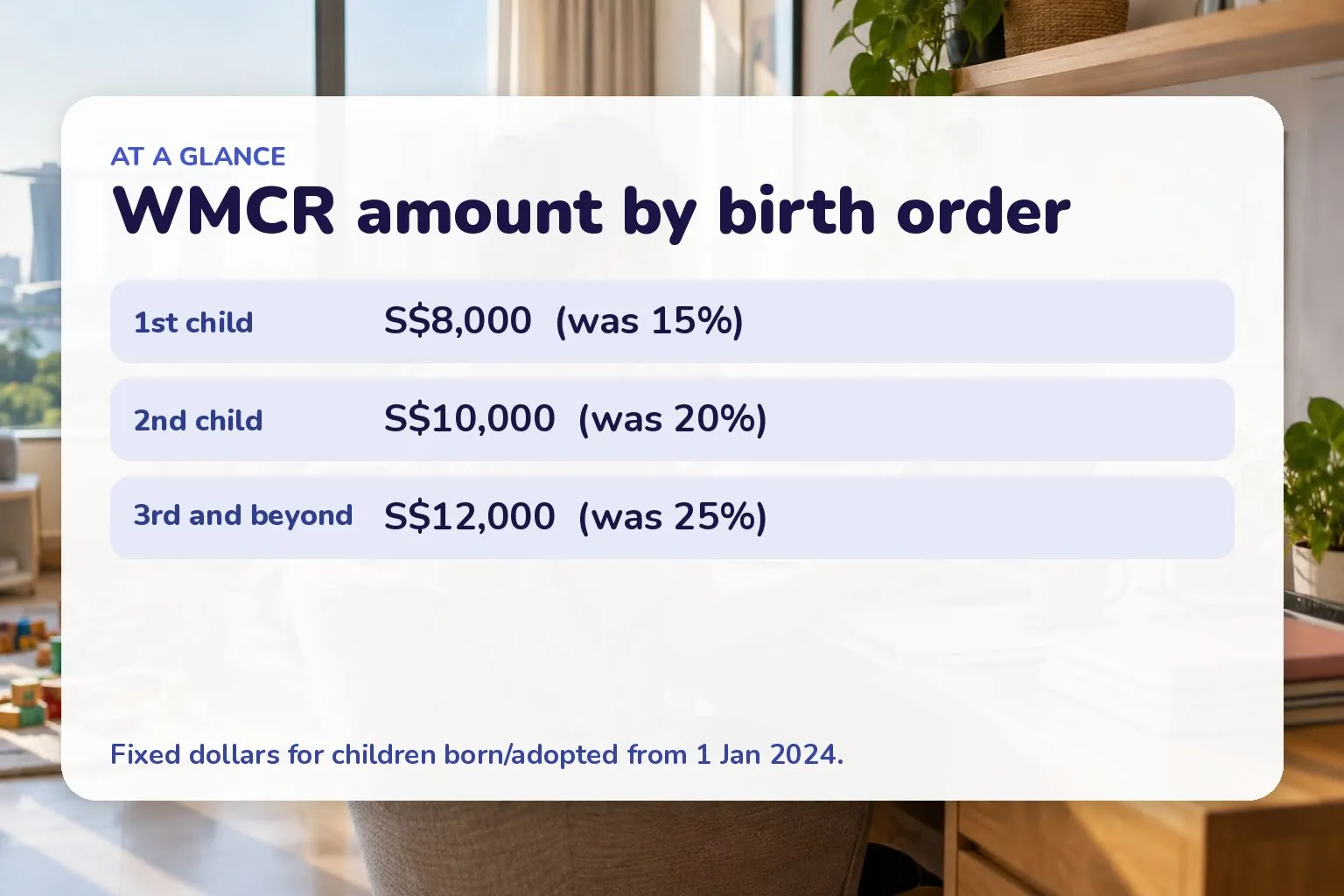
WMCR by birth order for children born/adopted from 1 Jan 2024, with the old percentage shown. Source: IRAS, October 2026.
| Child order | Born/adopted on or after 1 Jan 2024 | Born/adopted before 1 Jan 2024 |
|---|---|---|
| 1st child | S$8,000 | 15% of mother’s earned income |
| 2nd child | S$10,000 | 20% of mother’s earned income |
| 3rd and beyond | S$12,000 | 25% of mother’s earned income |
Because the new amounts are flat, there is a crossover point. For a first child, the fixed S$8,000 beats the old 15% formula whenever earned income is below about S$53,000 (15% of S$53,333 is S$8,000); above that, the old percentage would have been larger. That is the trade-off behind the reform — it steers more relief towards lower earners.
Qualifying conditions
WMCR rides on the same child conditions as the Qualifying Child Relief (QCR). For the relief in respect of a child, in the preceding year the child must have been:
- Unmarried, and
- Below 16 years old, or 16 and above but studying full-time at a school, college or university, and
- Earning an annual income of not more than S$8,000 (this threshold was raised from S$4,000 from YA 2025; scholarships and bursaries don’t count).
Child order is set by date of birth or adoption shown on the documents, and a deceased or stillborn child is still counted in the order — so a later surviving child keeps its true birth-order amount.
How WMCR stacks with QCR
You can claim both QCR and WMCR on the same child. QCR is S$4,000 per child (Child Relief (Disability) is S$7,500). The order of claiming matters:
- QCR / Child Relief (Disability) is allowed first — whether claimed by the father or the mother.
- WMCR takes the remaining balance up to the per-child cap.
The caps that limit your claim
Three ceilings apply, and they bite in this order:
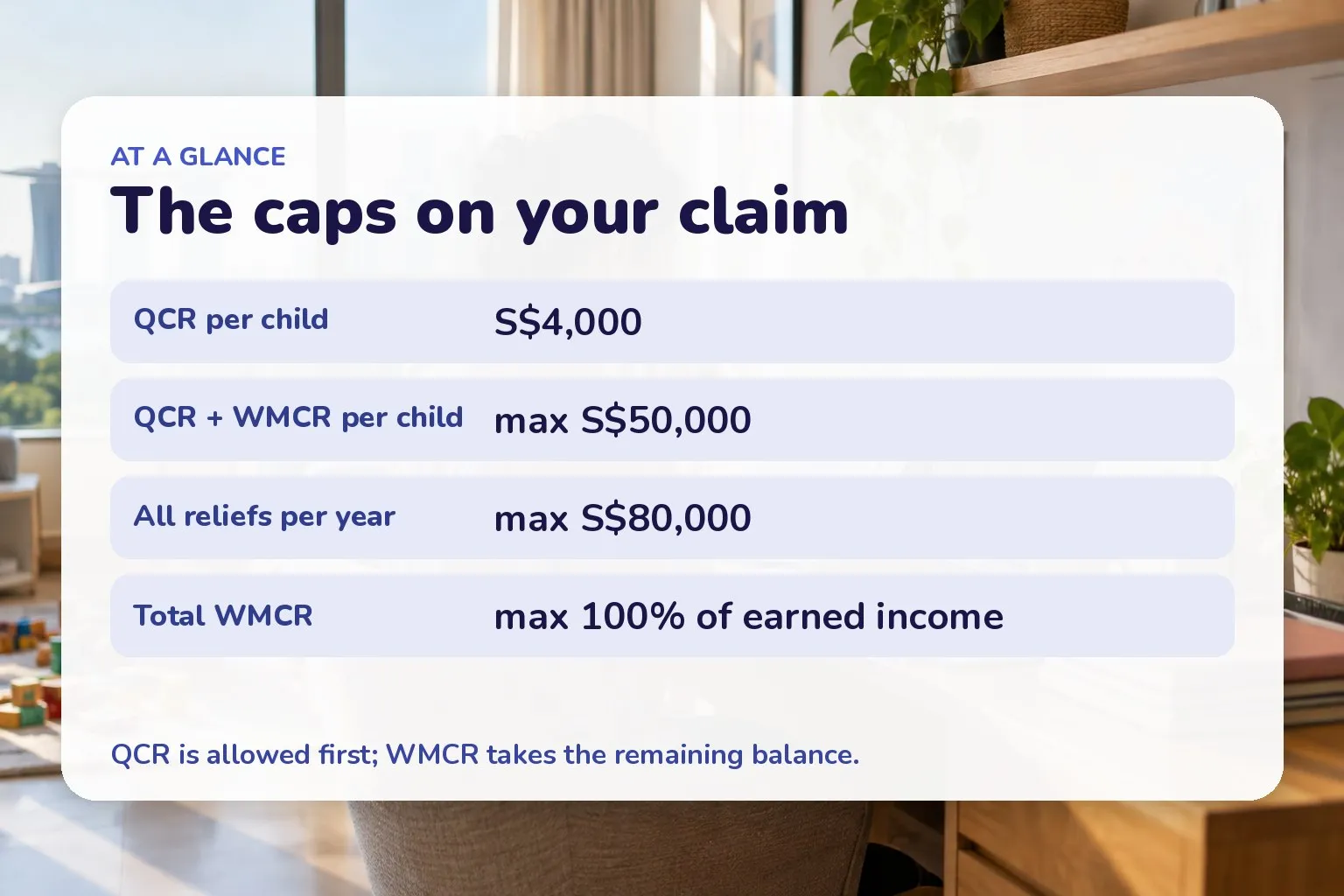
The ceilings that cap a WMCR claim. Source: IRAS, October 2026.
- 100% of earned income: your total WMCR across all children cannot exceed your own earned income. A mother earning S$15,000 with two pre-2024 children gets S$2,250 (15%) for the first, but the second is limited to S$7,000 so the total stays at S$15,000.
- S$50,000 per child: QCR/Child Relief (Disability) plus WMCR on any one child cannot exceed S$50,000. Since QCR is allowed first, a mother claiming S$4,000 QCR can take at most S$46,000 of WMCR on that child.
- S$80,000 overall: all your personal income tax reliefs combined — WMCR, QCR, CPF, Earned Income Relief and the rest — are capped at S$80,000 per YA.
WMCR vs the Parenthood Tax Rebate
People mix these up. WMCR is a relief — it lowers the income you are taxed on. The Parenthood Tax Rebate (PTR) is a rebate — a one-off credit that is subtracted directly from the tax you owe, and any unused balance carries forward to future years. PTR is worth S$5,000 for a first child, S$10,000 for a second and S$20,000 for each third and subsequent child, and both parents can share it. You can hold both at once; WMCR shrinks the bill, PTR then wipes out more of what’s left.
A worked example
Illustrative, using IRAS’s own figures. Mrs Chen’s first child (a Singapore Citizen) was born in 2025. Her earned income for the year was S$80,000, and she claims the full S$4,000 QCR herself.
| Item | Amount |
|---|---|
| Employment income | S$80,000 |
| Less: Earned Income Relief | S$1,000 |
| Less: Qualifying Child Relief | S$4,000 |
| Less: Working Mother’s Child Relief (1st child, fixed) | S$8,000 |
| Less: CPF Relief (illustrative) | S$16,000 |
| Chargeable income | S$51,000 |
Her WMCR is the flat S$8,000 because the child was born after 1 January 2024. If that same first child had been born in 2023, her WMCR would instead be 15% of S$80,000 = S$12,000 — a reminder that higher earners could do better under the old rule, while lower earners do better under the new one. On top of this, the couple’s PTR of S$5,000 is a separate credit against the tax finally payable.
FAQ
Does rental or investment income count? No. WMCR is based on earned income — pay from employment, or profit from a trade, business, profession or vocation. In IRAS’s own example, a mother with S$15,000 of earned income and S$30,000 of rental income has her total WMCR capped at S$15,000, because only the earned income counts towards the 100% ceiling.
What if I only worked part of the year? For a child born or adopted from 1 January 2024 the relief is the fixed amount by birth order, so part-year earnings do not scale it down — you only need to have had some earned income. For older children on the percentage rule, the relief is a share of whatever earned income you actually made that year.
Can I claim for a child born overseas? Yes, provided the child is a Singapore Citizen and meets the usual child conditions. WMCR is designed partly to encourage parents to take up citizenship for their children.
How to claim
Claim through myTax Portal with your Singpass when you file: go to the reliefs section, add your child, and indicate the WMCR claim. If the relief was allowed to you last year, IRAS pre-fills and grants it automatically — but always check the amount matches your child’s correct birth order and birth date.
WMCR is one piece of the parenthood support picture. It works alongside the cash and co-savings of the Baby Bonus and CDA, the MediSave help around the birth, childcare subsidies once preschool starts, and paid maternity and paternity leave.
Related
- Baby Bonus scheme explained
- MediSave for maternity and your newborn
- Childcare subsidy explained
- Maternity and paternity leave
General information, not tax or financial advice. Reliefs and caps change — confirm your own figures with IRAS before you file.
Sources
- Working Mother's Child Relief (WMCR) — Inland Revenue Authority of Singapore (as of October 2026)
- Qualifying Child Relief (QCR)/Child Relief (Disability) — Inland Revenue Authority of Singapore (as of October 2026)
- Tax savings for married couples and families — Inland Revenue Authority of Singapore (as of October 2026)
- Parenthood Tax Rebate (PTR) — Inland Revenue Authority of Singapore (as of October 2026)
- Adjustments of Marriage and Parenthood tax measures — Inland Revenue Authority of Singapore (as of October 2026)
- Tax Reliefs and Rebate for families — Made For Families (Government of Singapore) (as of October 2026)