Budgeting for a Baby: The First Year in Singapore
Plan the first year in four buckets — one-off setup, recurring monthly costs, healthcare and childcare — then set them against the support that lands the same year: up to S$6,000 in Baby Bonus cash, a S$5,000 CDA grant and a S$5,000 MediSave grant.
On this page10 sections · tap to jump
A baby’s first year in Singapore is less scary to budget for once you split it into four buckets — one-off setup, recurring monthly costs, healthcare, and childcare — and line them up against the Government support that arrives in the same twelve months. The support figures below are official (MSF, LifeSG, CPF and ECDA), as of October 2026; the spending figures are planning ranges, because what you actually spend on gear and nappies varies hugely by choice.
The first-year money map
Think of the year as costs on one side and support on the other. Your real first-year number is what is left after the support lands — and for many citizen families that gap is far smaller than the headlines suggest.
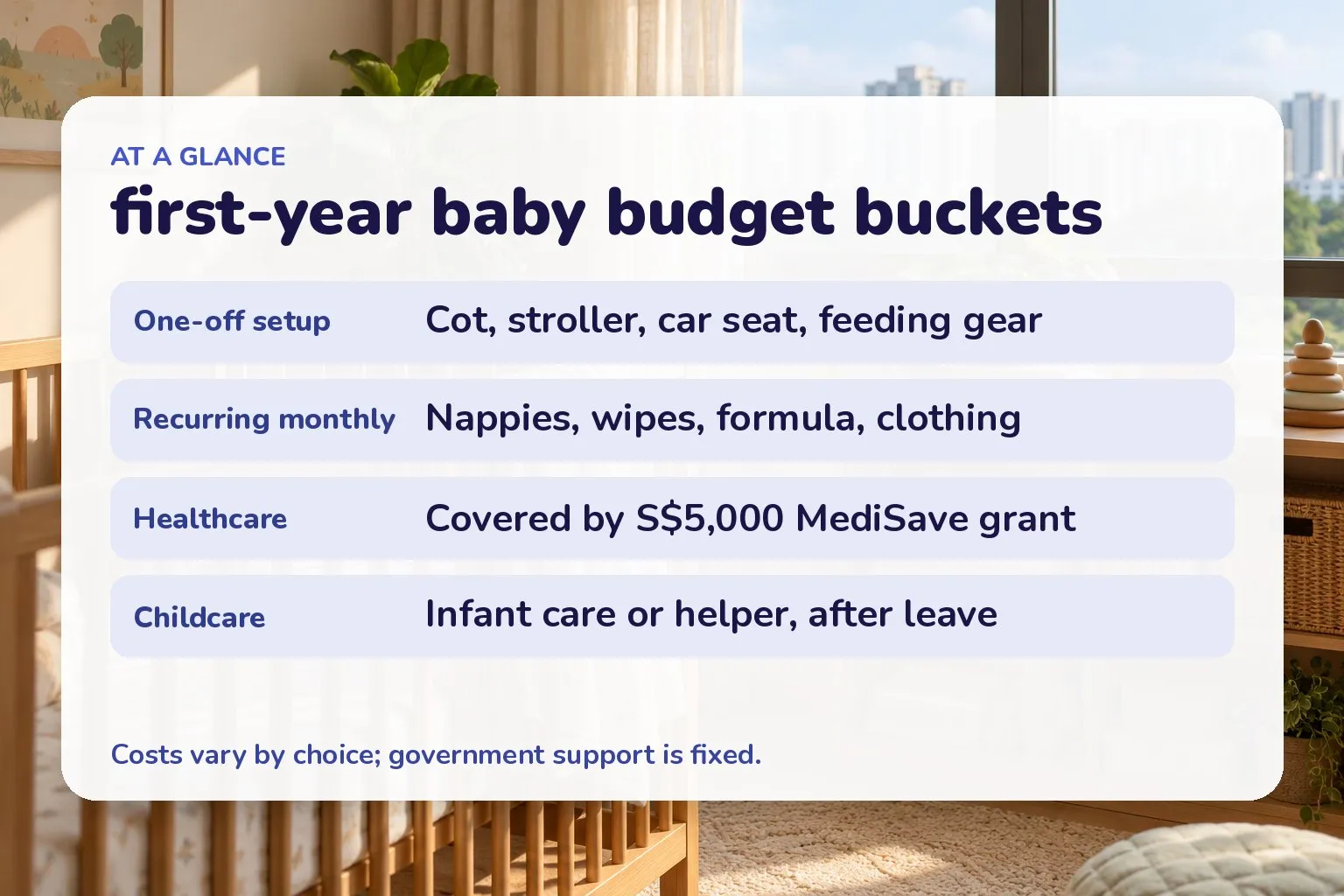
The four buckets to plan for a baby’s first year in Singapore.
| Bucket | What’s in it | Rough timing |
|---|---|---|
| One-off setup | Cot, mattress, stroller, car seat, carrier, feeding gear, first clothes | Before and just after birth |
| Recurring monthly | Nappies, wipes, formula (if used), clothing, sundries | Every month |
| Healthcare | MediShield Life premium, recommended vaccinations, check-ups | Spread across the year |
| Childcare | Infant care fees, or a helper, once leave ends | From ~4–12 months |
The delivery itself is a separate bucket we cover in pregnancy and delivery costs; this page picks up from the day you bring the baby home.
One-off setup costs
This is the bucket parents most over-spend on, because it is the most optional. A cot and mattress, a stroller, a car seat (needed the day you leave hospital), a carrier, feeding equipment and a first run of clothes make up the core. Prices swing enormously — a car seat alone can be under a hundred dollars or several hundred — so treat this as a bucket you decide, not one that is fixed. Our newborn essentials checklist lists what is genuinely needed versus nice-to-have, and where borrowing or buying second-hand is sensible. Budget a realistic figure for your choices and remember that hand-me-downs and gifts routinely cover a large part of it.
Recurring monthly costs
The steady monthly spend is nappies, wipes, and — if you are not exclusively breastfeeding — formula, plus a trickle of new clothes as the baby grows. None of these have an official price, and they vary by brand and feeding choice, so put your own figure in. The useful budgeting habit is to estimate a monthly number and multiply by twelve early, rather than absorbing it as it comes. Our cost-of-raising-a-child tool lets you test different assumptions.
The big recurring choice: care
The single largest swing in a first-year budget is how you cover childcare once parental leave ends. The two mainstream routes are an infant care centre or a migrant domestic worker (helper), and we compare them in detail in infant care vs hiring a helper.
For infant care, the fee is capped at government-supported centres: S$1,235 a month at an Anchor Operator and S$1,290 at a Partner Operator (excluding GST). Against that, every Singapore Citizen child gets a S$600 Basic Subsidy if the mother works, and a working mother within the income ceiling gets an Additional Subsidy of up to S$710 — so a lower-income family can bring a capped infant-care fee down to a few hundred dollars, while a higher earner pays closer to the cap minus S$600. That difference, hundreds of dollars a month, dwarfs the nappy budget, so decide the care route before you fine-tune anything else. (For the full tables, see the childcare and infant care subsidy guide.)
Support that lands in year one
Here is what the Government puts in during the same twelve months, for a Singapore Citizen child of lawfully married parents.
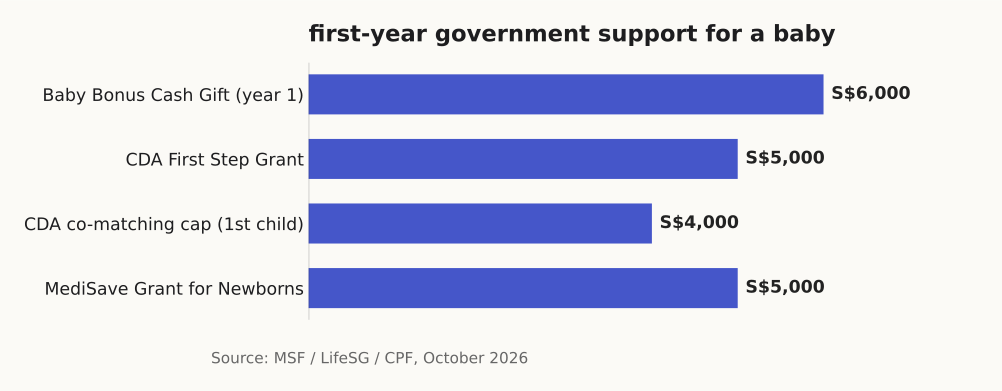
Official support for a first Singapore Citizen child in year one. Source: MSF, LifeSG and CPF, October 2026.
| Support | First-child amount | When it lands |
|---|---|---|
| Baby Bonus Cash Gift | S$3,000 at birth, S$1,500 at 6 months, S$1,500 at 12 months (S$6,000 in year one) | Every 6 months into the CSA |
| CDA First Step Grant | S$5,000, no saving required | Soon after you open the CDA |
| CDA Government co-matching | Up to S$4,000 (1st child), dollar-for-dollar on your deposits | As you save |
| MediSave Grant for Newborns | S$5,000 into the child’s MediSave | Within a week of birth registration |
The Baby Bonus Cash Gift totals S$11,000 for a first or second child (S$13,000 from the third), paid every six months until the child turns 6.5. In the first year you receive S$6,000 of it for a first or second child (S$8,000 from the third). It goes into the Child Savings Account (CSA), a joint account you can withdraw from in cash to meet early-childhood expenses.
The Child Development Account (CDA) is different. Its First Step Grant — S$5,000 for a first or second child, S$10,000 from the third (born on or after 18 February 2025) — lands automatically when you open the account, with no deposit needed. On top of that the Government co-matches every dollar you save, up to S$4,000 for a first child, S$7,000 for a second, and S$9,000 for a third or fourth. But CDA money can only be spent at Approved Institutions — preschools, clinics, pharmacies — and cannot be withdrawn as cash.
Baby’s healthcare: mostly pre-funded
Your baby’s own healthcare is largely covered before you spend a cent of cash. Every Singapore Citizen newborn born on or after 1 April 2025 receives a S$5,000 MediSave Grant for Newborns, credited automatically to the child’s MediSave account within a week of birth registration. It pays the child’s MediShield Life premiums, recommended childhood vaccinations, hospitalisation and approved outpatient treatments — and the balance earns 4% a year. You cannot take it as cash, but it means the recommended vaccination schedule and the baby’s insurance premiums come out of this grant, not your pocket, for years.
Your income while on leave
The income side of year one is cushioned by paid leave. A working mother with a Singapore Citizen child and at least three months’ service gets 16 weeks of Government-Paid Maternity Leave, and fathers get up to 4 weeks of Government-Paid Paternity Leave. For a child born on or after 1 April 2026, parents also share 10 weeks of Shared Parental Leave (government-paid up to S$2,500 a week) — bringing the combined total to about 30 weeks of paid leave across both parents in the infancy stage. Plan the month your pay steps back down to normal, because that is usually the month infant-care fees begin.
A worked first-year budget (illustrative)
The spending numbers above are illustrative; swap in your own gear choices, feeding plan and care route. The support numbers are fixed by the schemes.
What the 2027 change means
A baby born today is enrolled under the current Baby Bonus Scheme, and its payouts continue as normal. From April 2027 the Government’s new SG Child Support Package replaces the Baby Bonus and Large Families schemes, and children already enrolled are transitioned automatically — you do nothing. The Package keeps the CDA grant and co-matching, continues cash support, and adds Child Credits of S$2,000 a year for children aged 1 to 16 from 2026 onwards, with the first payout from April 2027. In short, a baby born now does not lose out: existing Cash Gift payments run to 31 March 2027, a top-up follows, and the new recurring Child Credits begin.
FAQ
Can I actually spend the Baby Bonus cash? Yes. The Cash Gift sits in the Child Savings Account, a joint savings account you can withdraw from in cash for early-childhood expenses. The CDA and MediSave grants, by contrast, are ring-fenced for approved child and healthcare expenses.
Do both parents need to be working to get support? No. The Baby Bonus Cash Gift, CDA grants and MediSave grant do not depend on employment — they need a Singapore Citizen child and (for the Cash Gift) lawfully married parents. Paid leave and the working-mother childcare subsidies are the parts tied to employment.
What if we’re not married or the child isn’t a citizen? The Cash Gift requires lawfully married parents; some CDA benefits extend to children of single unwed parents born on or after 1 September 2016. Non-citizen newborns are not eligible for the S$5,000 MediSave grant. Check your child’s eligibility on LifeSG.
Is delivery included in this budget? No — the hospital bill is a separate bucket, covered in pregnancy and delivery costs, where MediSave and subsidies do most of the work.
Related
- Baby Bonus scheme explained
- Child Development Account (CDA)
- Infant care vs hiring a helper
- Newborn essentials checklist
- Cost of raising a child calculator
General information, not financial advice. Support amounts and rules change — check the official LifeSG, Made For Families, CPF and ECDA pages before you budget.
Sources
- Baby Bonus Scheme (Cash Gift and CDA) — Made For Families (Government of Singapore) (as of October 2026)
- Baby Bonus Cash Gift and Child Savings Account (CSA) — LifeSG (Government of Singapore) (as of October 2026)
- Baby Bonus Child Development Account (CDA) — LifeSG (Government of Singapore) (as of October 2026)
- MediSave Grant for Newborns — Made For Families (Government of Singapore) (as of October 2026)
- SG Child Support Package — LifeSG (Government of Singapore) (as of October 2026)
- Anchor Operator scheme fee caps — Early Childhood Development Agency (as of October 2026)
- Government-Paid Maternity Leave — Made For Families (Government of Singapore) (as of October 2026)