Financial Help for Preschool Fees in Singapore
Help comes by stage: the infant and childcare subsidy takes up to about S$1,310 a month off infant care; the Kindergarten Fee Assistance Scheme (KiFAS) covers MOE and Anchor kindergartens; and the one-off S$1,000 Start-Up Grant covers enrolment costs. All are paid straight to the centre.
On this page12 sections · tap to jump
- 01The help, by stage
- 02Infant care and childcare subsidies
- 03Kindergarten: KiFAS
- 04The fee caps that set the ceiling
- 05Enrolment costs: the Start-Up Grant
- 06Lower-income and hardship help
- 07If you’re not working
- 08Why the fee is never zero
- 09How to apply
- 10What changes from 2027
- 11If it’s still unaffordable
- 12FAQ
Singapore does not have one preschool subsidy — it has a set of schemes, and which one helps you depends on your child’s stage (infant care, childcare or kindergarten) and your household income. The figures below are ECDA’s and MOE’s, as of October 2026. Every subsidy on this page is paid directly to your centre, so you only ever pay the fee that is left.
The help, by stage
Match your child to the right scheme first; the rest of this page explains each one.
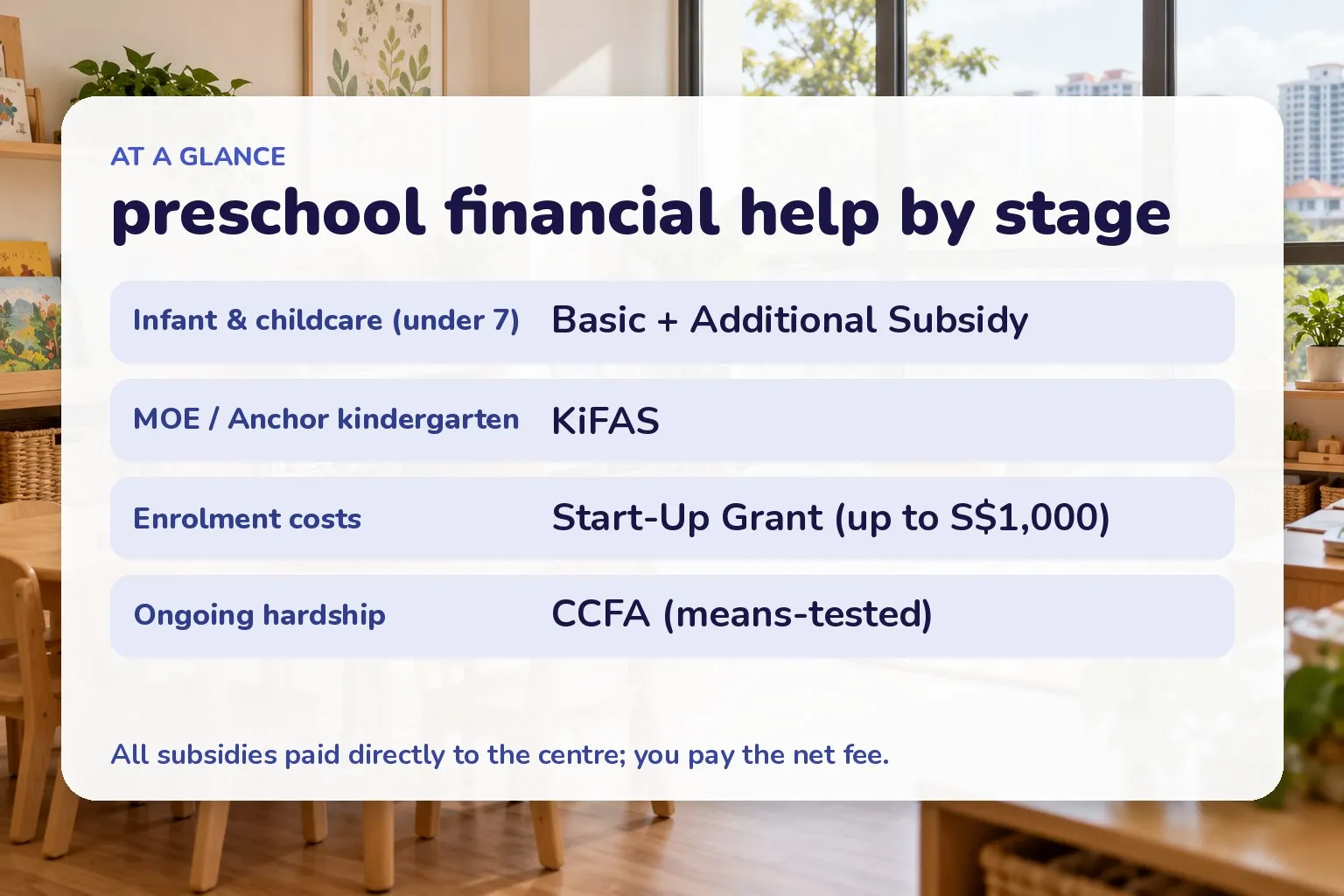
Which scheme fits your child’s stage. Source: ECDA, October 2026.
| Stage | Main scheme | Who it is for |
|---|---|---|
| Infant care (2–18 months) & childcare (18 months–below 7 years) | Basic + Additional Subsidy | All SC children (Basic); working mothers within the income ceiling (Additional) |
| Kindergarten at MOE or Anchor Operator (K1–K2) | Kindergarten Fee Assistance Scheme (KiFAS) | SC children, means-tested |
| Enrolment costs (deposit, uniform, insurance) | Start-Up Grant (SUG) | Lower-income families, one-off |
| Ongoing hardship after subsidies | Child Care Financial Assistance (CCFA) | Lower-income families in difficult circumstances |
Private kindergartens and private childcare centres that are not Anchor or Partner Operators charge their own fees; the subsidies still apply at any ECDA-licensed infant or childcare centre, but KiFAS does not apply to private kindergartens.
Infant care and childcare subsidies
This is the workhorse scheme for children under seven at a licensed infant care or childcare centre. There are two layers. The Basic Subsidy goes to every Singapore Citizen (SC) child with no income test: S$600 a month for infant care and S$300 for childcare if the mother works, or a flat S$150 if she does not. On top of that, working mothers (or single fathers in divorce, separation or widowhood cases) with a gross monthly household income of S$12,000 or below — or per capita income of S$3,000 or below for households of five or more — get an income-tested Additional Subsidy of up to S$710 for infant care and up to S$467 for childcare. A “working” applicant works at least 56 hours a month, and full-time, part-time and freelance all count.
At the lowest income tier that adds up to as much as S$1,310 a month off infant care and S$767 off childcare, before the minimum co-payment. The exact amount tapers as income rises.
For the full income-tier tables, the minimum co-payment at each tier and the half-day and flexi-care rates, see our detailed guide to the childcare and infant care subsidy. You can also estimate your own figure with the childcare subsidy calculator.
Kindergarten: KiFAS
Kindergartens use a separate scheme. The Kindergarten Fee Assistance Scheme (KiFAS) helps SC children enrolled at a Ministry of Education (MOE) kindergarten or an Anchor Operator (AOP) kindergarten whose gross monthly household income is S$12,000 or less, or per capita income S$3,000 or less for households of five or more. The subsidy is means-tested: the lower your income, the more you receive, with a minimum co-payment that rises with income.
ECDA’s own example: a family earning S$3,000 or below qualifies for a maximum KiFAS subsidy of S$163 with a S$1 minimum co-payment. If the child’s monthly fee is S$160, the subsidy paid is S$159 (because of the S$1 floor) and you pay S$1.
KiFAS has one important limit: it applies only to MOE and Anchor Operator kindergartens. Children in private kindergartens are not eligible. If you are weighing options, see our MOE Kindergarten guide and the overview of preschool types in Singapore.
The fee caps that set the ceiling
Government funding also holds the sticker price down at Anchor and Partner Operator centres, which is what makes the subsidies go so far. ECDA requires Anchor Operators to keep monthly fees (excluding GST) at or below S$1,235 for full-day infant care, S$610 for full-day childcare, and S$150 for kindergarten. Partner Operators cap full-day infant care at S$1,290 and childcare at S$650. An MOE Kindergarten charges a flat S$160 a month for SC children in 2026 (S$320 for PRs); its full-day Kindergarten Care add-on is capped at S$425 a month for 2026.
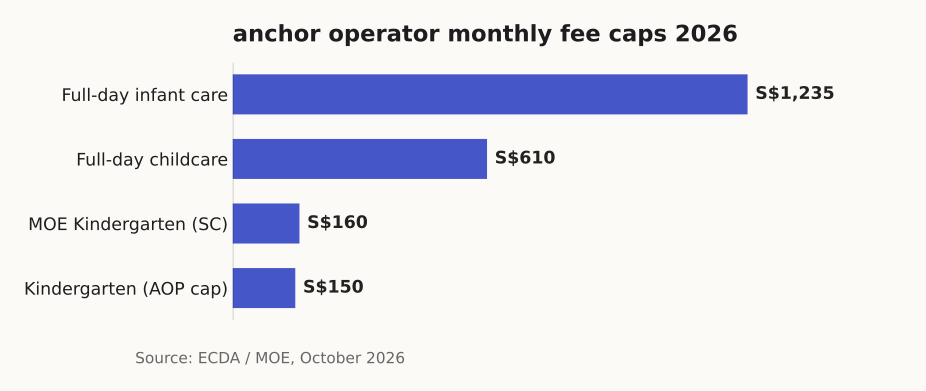
Monthly fee caps at Anchor Operator centres and MOE Kindergarten, before GST. Source: ECDA and MOE, October 2026.
Because the fee itself is capped, a modest subsidy often covers most of it — a working mother at the lowest income tier can bring a S$610 Anchor Operator childcare fee down to around the S$58 minimum co-payment for her tier.
Enrolment costs: the Start-Up Grant
Subsidies cover the monthly programme fee, not the costs of getting in. The Start-Up Grant (SUG) is a one-time grant, capped at S$1,000 per child (inclusive of GST), that covers the registration fee, deposit, school uniform, insurance and mattress when you enrol an SC child in an affordable infant or childcare centre. A child can normally benefit from the SUG once; a repeat needs an appeal to MSF through the preschool.
Lower-income and hardship help
Two further schemes sit below the standard subsidies for families who need more. Child Care Financial Assistance (CCFA) is for a lower-income family in difficult circumstances who still cannot manage the fee after the Basic and Additional Subsidies. To qualify, the SC child must be in a full-day programme at an affordable centre, the main applicant must be working (or have a valid reason not to be, such as job-seeking or being medically unfit), and gross monthly household income must be S$3,500 or less, or per capita income S$875 or less. The amount is assessed case by case.
Families on HDB’s Public Rental Scheme or ComCare assistance, as noted above, also receive maximum subsidies under Special Approval.
If you’re not working
You are not shut out if the main applicant is not employed. From 9 December 2024, a family with a childcare child and gross monthly household income of S$6,000 and below (or PCI S$1,500 and below) gets the full childcare subsidies regardless of working status, until the next fixed point of assessment. If that does not apply — your child is in infant care, or in childcare with income above S$6,000 — a non-working applicant can apply for time-limited full subsidies under Special Approval (SA) when they cannot work for a specified reason (for example medical, caregiving, pregnancy or job-seeking).
Why the fee is never zero
How to apply
Your preschool handles the paperwork. Since end-March 2025, all parents apply through LifeSG Form 1 at enrolment, which covers subsidies, the Start-Up Grant and CCFA in one submission; income is means-tested through the government’s HOMES system. You can ask for a reassessment any time your circumstances change. Your child must attend for at least one day in a month to receive that month’s subsidy, which is paid straight to the centre.
What changes from 2027
At Budget 2026 the Government confirmed that from 1 January 2027 the income ceiling for both the Infant and Childcare Additional Subsidy and KiFAS rises from S$12,000 to S$15,000, with higher caps across the tiers; MOE’s fees page notes the same change. The move is expected to help more than 60,000 families. ECDA will publish the exact 2027 tier tables closer to the date — until then, the figures above are the rules in force.
If it’s still unaffordable
If your family still struggles after every subsidy, speak to your preschool, which can raise an appeal to ECDA or MSF, and ask about CCFA. Families facing a one-off crisis can also approach a Social Service Office (SSO) for ComCare support. The point of the stacked schemes is that no eligible SC child is kept out of preschool by fees alone.
FAQ
Do permanent residents get these subsidies? The infant and childcare subsidies and KiFAS are for Singapore Citizen children. PR children pay the unsubsidised fee; an MOE Kindergarten, for instance, charges PRs S$320 a month in 2026.
Can I get KiFAS and the childcare subsidy at the same time? Not for the same child at the same time — they cover different stages. A younger sibling in childcare can draw the childcare subsidy while an older sibling in K1 draws KiFAS.
Is the subsidy paid to me in cash? No. Every subsidy on this page is paid directly to the centre; you pay only the net fee.
What if my income rises mid-year? Your subsidy stays fixed until the next fixed point of assessment unless you request a reassessment.
Related
- Childcare and infant care subsidy explained
- Childcare subsidy calculator
- MOE Kindergarten guide
- Types of preschools in Singapore
General information, not financial advice. Your exact subsidy depends on a verified income check by ECDA.
Sources
- Overview of the infant and childcare subsidy scheme — Early Childhood Development Agency (as of October 2026)
- Overview of the Kindergarten Fee Assistance Scheme (KiFAS) — Early Childhood Development Agency (as of October 2026)
- Other financial assistance for preschool fees (CCFA and Start-Up Grant) — Early Childhood Development Agency (as of October 2026)
- What are the benefits for parents under the Anchor Operator scheme? (fee caps) — Early Childhood Development Agency (as of October 2026)
- MOE Kindergarten: Fees and financial assistance — Ministry of Education (as of October 2026)